To How to Authenticate Text Messages for Court, you show the judge two things. The texts are real, and the right person sent them. Federal Rule of Evidence 901 sets this standard.
Texts are everywhere in disputes. Americans exchanged more than 2.2 trillion texts in 2024, so judges see text message evidence all the time. A plain screenshot, though, is just an image. This guide shows how to make texts admissible in court.
Table of Contents
What Does It Mean to Authenticate Text Messages for Court?

Authentication is the first gate for any exhibit. It answers one question: is this item what you say it is?
Rule 901(a) asks for enough proof to support a finding that the item is genuine. The bar is low. Courts often call it a prima facie showing. The judge decides this preliminary question under Rule 104.
While text messages can serve as important evidence in legal matters, they also play a meaningful role in everyday professional communication. If you’re looking for the right words to express appreciation when leaving a job, explore these thank you messages for resignation to share your gratitude with bosses, coworkers, and teammates.
Authentication is not the only hurdle. Four rules often get mixed up:
Authentication proves the text is genuine. Relevance shows it matters to the case. Hearsay rules ask whether the words can be used for their truth. The best evidence rule asks whether a copy is allowed.
Texts from the opposing party are usually not hearsay under Rule 801(d)(2). A printout of stored data also counts as an “original” under Rule 1001(d).
State courts follow similar rules. Texas, Wisconsin, North Carolina and Massachusetts all apply versions of Rule 901. Details differ, so check your state’s rules. The standard is the same in civil and criminal cases.
Judges reject texts for three main reasons: no foundation, missing context, or signs of fakery.
Authenticating text messages for court requires careful attention to the words we send, preserve, and share. Beyond legal matters, messages also help us celebrate meaningful moments and express good wishes, especially through heartfelt New Year messages and wishes that bring people closer as a new year begins.
How to Authenticate Text Messages as Evidence, Step by Step

Follow these steps in order. They work for most text message evidence.
Preserve the full thread. Save every message, including the ones you sent. Keep dates, times and contact details. Never delete anything once a dispute begins. If the other side holds texts, send a written preservation request.
Capture the conversation. Use screenshots, photos or printouts. Show the whole thread, not isolated lines. For high-stakes cases, add a forensic export.
Identify both parties. Show the phone numbers, names and devices on each side.
Link the texts to a person. Use the proof methods in the next section.
Prepare a witness or affidavit. Under Rule 901(b)(1), a witness with knowledge can say the exhibit is accurate. A simple foundation statement looks like this:
I received these text messages on my phone, and this exhibit is a true and accurate copy of them as they appeared on my screen.
Check for self-authentication. Since 2017, Rule 902(13) and 902(14) let a qualified person certify electronic records. This can replace live testimony. Data copied from a device can be verified by hash value, a digital fingerprint.
Handle hearsay and best evidence early. Name the exception or confirm the copy is allowed.
Offer the exhibit. Lay the foundation, move it into evidence, and be ready for objections.
Common mistakes include cropped threads, missing timestamps, a deleted original, and leaning on a phone number alone.
How to Prove Who Sent a Text Message
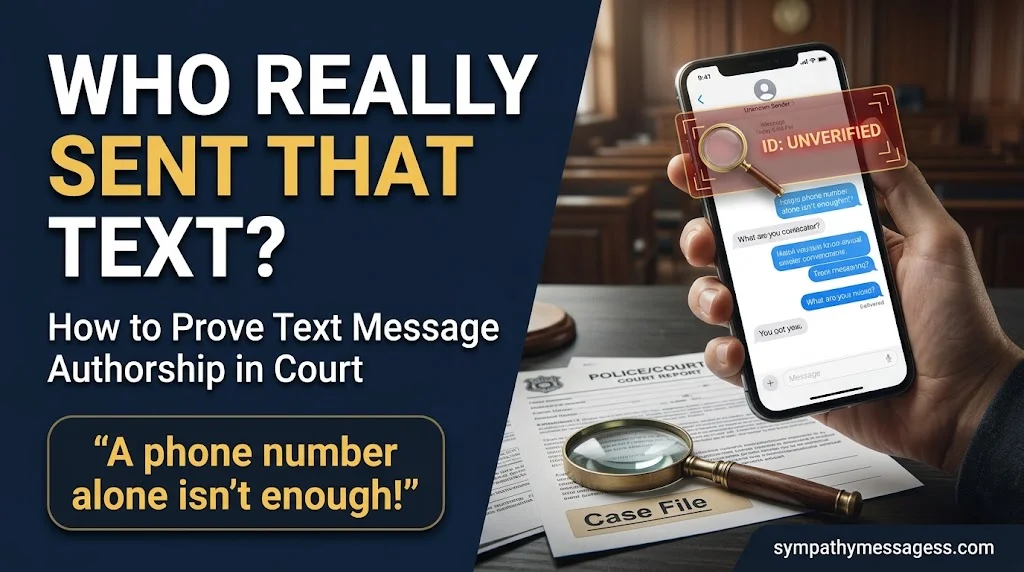
How can you prove who sent a text message? Show that the person wrote it, not just that it came from their number. This is the authorship question, and it is where most fights happen.
In Garnett v. Commonwealth (Va. Ct. App. 2016), the court listed five accepted ways to prove authorship:
The sender admits it. A witness saw the sender write it. Carrier records show it came from the sender’s phone, and only the sender would have access. The text holds facts only the sender would know. Or the sender’s reply shows they wrote the earlier message.
A phone number alone is weak. Phones get lost, borrowed and spoofed. In Tienda v. State, 358 S.W.3d 633 (Tex. Crim. App. 2012), the court said a number tied to a person is not enough by itself. In Butler v. State, 459 S.W.3d 595 (Tex. Crim. App. 2015), it compared a number to a return address on a letter.
Circumstantial evidence can fill the gap. Look for nicknames, writing style, emoji habits, shared events and timing. In State v. Giacomantonio, 2016 WI App 62, a detective’s testimony and message timing were enough. In People v. Rodriguez, 38 N.Y.3d 151 (2022), a witness who confirmed the screenshots were accurate carried the day.
Practical tools help too. Subpoena the carrier for records. Ask for testimony from someone who texted with the sender. In civil cases, serve requests for admission.
Watch for spoofing. Fake sender numbers and fake-chat generators are easy to find online.
Screenshots, Deleted Texts and Forensic Proof

Can screenshots of text messages be used as evidence in court? Yes. A witness must confirm they are accurate, and other proof should link the texts to the sender. A screenshot alone is risky because it lacks metadata and is easy to edit.
Fake screenshots often show mismatched fonts, odd spacing, cropped contacts, gaps in the thread or timestamp problems. These are red flags, not proof. Skilled fakes may show none of them.
Forensic extraction goes deeper. Tools such as Cellebrite and Magnet AXIOM copy the device’s message databases. On iPhones that is sms.db. On Android it is often mmssms.db. The copy holds timestamps, sender IDs, delivery status and thread data. A matching hash value proves the copy was not changed. Documented chain of custody adds trust.
Can deleted text messages be recovered and used as evidence? Sometimes. Deleted texts may survive in the phone’s storage, in cloud backups or on the other person’s device. Carrier logs may show that messages were sent, but many carriers keep little or no message content. Recovered texts still need authentication.
Deleting texts after a dispute starts is risky. Courts can impose sanctions for spoliation, including under Federal Rule of Civil Procedure 37(e).
Consider an expert when authorship is disputed, messages were deleted, or the stakes are high.
FAQs
How do you authenticate text messages for court?
Show the texts are genuine and tied to the sender. Use a witness, distinctive content, carrier records or forensic proof under Rule 901. Preserve the full thread first.
Can screenshots of text messages be used as evidence in court?
Yes, if a witness confirms they are accurate and other evidence links them to the sender. On their own, screenshots are easy to challenge.
How can you prove who sent a text message?
Use an admission, carrier records, details only the sender knew, reply context or witness testimony. A phone number alone is usually not enough.
Do text messages need to be notarized to be admissible in court?
No. Notarization is not required. A sworn affidavit or a Rule 902 certification is the useful tool. A short statement like this can help:
I certify that the attached text messages are true copies of messages stored on my device, and I have not altered them.
Can deleted text messages be recovered and used as evidence?
Sometimes. Forensic tools or backups may recover them. They still need authentication, and you should not delete anything once a dispute begins.
Conclusion
To authenticate text messages for court, preserve the whole thread, prove who sent it, and back it up with a witness or forensic proof. Rules vary by state, so confirm local requirements. This is general information, not legal advice. For a real case, talk to a licensed attorney.

Timmy Ehtisham is the founder and lead content writer at Sympathy Messages, where he creates thoughtful, heartfelt, and meaningful messages for life’s most important moments. With a passion for helping people express their emotions through words, Timmy specializes in writing sympathy messages, condolences, wishes, greetings, quotes, captions, and puns that are both sincere and easy to personalize.